

Picking from the best book publishing companies feels a lot like online dating, since everyone smiles, everyone promises the moon, and a few just want your credit card.
The best book publishing option depends on your budget, how much control you want, and how much work you are willing to manage.
Traditional book publishers in USA generally fund production in exchange for contractual rights, self-publishing platforms let authors publish directly, aggregators distribute books to multiple retailers, and paid publishing services provide professional help for an upfront fee.
Whether you’re looking for book publishing companies in Atlanta or book publishing services, this guide compares 15 providers by publishing model, pricing, distribution, royalty structure, and rights considerations. Where costs or terms depend on an individual contract, we say so.
Use the comparison to build a shortlist, then confirm the latest terms directly with each provider before committing.
KEY TAKEAWAYS
- Big traditional publishers pay you, but most want an agent first.
- Self publishing platforms cost little upfront, yet you pay for editing, covers, and ads.
- Hybrid publishers charge thousands, so demand a written quote and a clear rights clause.
- Never sign before you check royalties, ISBN ownership, refund terms, and exit rights.
Best Book Publishing Companies at a Glance
Here’s the short version. You get fifteen companies, four business models, and one big question, which is who pays whom. The table below puts every company side by side, so you can spot the trade offs in seconds. Read the Model column first, because it tells you who carries the cost. Next, read the Average Cost column, since that’s where most surprises hide.
The four models work like this. Traditional publishers pay you and keep most of the rights. Self publishing platforms let you keep everything but ask you to do the work. Aggregators send your ebook to many stores for a fee or a cut.
Hybrid and full service providers do the work for a price, and quality swings wildly from one to the next. Know the model before you compare prices, because a $12,000 hybrid package and a $0 platform solve different problems.
Prices come from each company’s own pages and help centers, checked in October 2026. Treat them as a starting point, and confirm them before you pay a cent for book publishing services.
| Company | Model | Services | Average Cost | Distribution | Net Royalties* and Rights | Best For |
| Liberty Book Writers | Managed Full-Service | Ghostwriting, editing, formatting, cover design, marketing, distribution | $1,000 – $5,000 | Amazon KDP, IngramSpark, Barnes & Noble, major retailers | 100% net royalties; author retains 100% rights | Authors seeking an all-in-one managed launch without technical headaches |
| Penguin Random House | Traditional (“Big 5”) | Editorial, design, manufacturing, global publicity, physical marketing | $0 upfront (Publisher pays author advance) | Global brick-and-mortar stores, airports, major online retailers | 10%–15% print list price, 25% ebook; publisher holds rights | Bestselling authors, public figures, high-profile debuts |
| HarperCollins | Traditional (“Big 5”) | Manuscript acquisition, professional production, global retail sales | $0 upfront (Publisher pays author advance) | International bookstore networks, libraries, mass market | 10%–15% print list price, 25% ebook; publisher holds rights | Mainstream literary fiction, non-fiction, franchise works |
| Simon & Schuster | Traditional (“Big 5”) | Editorial guidance, trade marketing, sales representation, printing | $0 upfront (Publisher pays author advance) | Worldwide bookstore chains, independent shops, digital outlets | 10%–15% print list price, 25% ebook; publisher holds rights | Established thought leaders, commercial fiction, memoirs |
| Hachette Book Group | Traditional (“Big 5”) | High-level editing, cover design, international sales, publicity | $0 upfront (Publisher pays author advance) | Global trade bookstore chains, libraries, major digital stores | 10%–15% print list price, 25% ebook; publisher holds rights | Commercial genre fiction, pop culture, non-fiction writers |
| Macmillan | Traditional (“Big 5”) | Full-scale publishing, publicity campaigns, retail placement | $0 upfront (Publisher pays author advance) | Worldwide physical bookshops, academic networks, online stores | 10%–15% print list price, 25% ebook; publisher holds rights | Academic scholars, YA fiction, high-concept fiction |
| Amazon KDP | Direct Retailer / Self-Publishing | Direct ebook & print-on-demand uploading, automated conversion | $0 upfront (Platform takes percentage per sale) | Non-exclusive globally, optional 90-day ebook exclusivity via KDP Select or wide paperback retail reach via Expanded Distribution. | 35% or 70% ebook, 60% print (minus print costs); author keeps 100% rights | DIY indie authors wanting fast, low-cost direct access |
| Lulu | Print-on-Demand (POD) | Custom print layout, direct-to-consumer store, ebook distribution | $0 platform fee (Pay per printed copy ordered) | Lulu Bookstore, direct website integrations, Ingram network | 80% net profit on direct sales; author retains 100% rights | Educators, niche project creators, authors selling directly |
| Atmosphere Press | Selective Hybrid Press | Professional developmental editing, layout, custom art, distribution | $7,200 – $14,700 | Global wholesale via Ingram, online retail networks | 90% net royalties; author retains 100% copyright | Literary fiction writers and poets seeking high editorial standards |
| Greenleaf Book Group | Premium Hybrid / Distributor | Editorial, luxury design, warehousing, direct retail sales representation | $20,000 – $50,000+ | Major physical bookstore chains, airport bookstores, online stores | ~70% net revenue; author retains 100% rights | Corporate executives, CEOs, established business speakers |
| She Writes Press | Community Hybrid Press | Developmental editing, cover art, track layout, traditional distribution | $5,000–$10,000 | Traditional physical distribution via Simon & Schuster / Ingram | 70% net royalties | Women authors and memoirists seeking community support |
| Amplify Publishing Group | Thought Leadership Hybrid | Corporate branding, executive editing, design, strategic launch | $10,000 – $25,000+ | Major retail networks, airport placement, online outlets | Custom high net profit split; author retains 100% rights | Entrepreneurs, keynote speakers, corporate leaders |
| PublishDrive | Flat-Fee Digital Aggregator | Single-upload ebook/POD distribution, global library networks | Monthly/annual subscription ($10–$100+/mo) | 400+ digital stores, Google Play, Apple, global libraries | 100% store royalties (zero commission cut); author retains 100% rights | High-volume indie authors with steady global sales |
| Forefront Books | Partnership Hybrid Press | Veteran editorial development, cover design, national publicity | $15,000 – $30,000+ | Mainstream retail bookstore distribution networks | High net royalty split; author retains 100% rights | Non-fiction authors with an established audience platform |
| StreetLib | Global Digital Aggregator | Multi-lingual distribution, ebook/audiobook upload, formatting | $0 setup (10% sales commission or annual plans) | International digital stores, European & Latin American markets | ~90% net royalties (minus store fees); author retains 100% rights | Authors expanding into international and non-English markets |
Key Takeaway. Free platforms cost you time, and paid packages cost you cash. Pick the trade you can live with.
Net Royalties = Net royalties refer to the income generated from a book sale after deductions for printing costs, store discounts, and payment fees have been accounted for. Instead of receiving a proportion of the book’s full retail price, you are entitled to a percentage of the remaining profit.
- Royalties are dependent on the contract, format, and basis of calculation.
How We Evaluated the Best Book Publishing Companies
We didn’t pick these companies out of a hat. Each one earned a spot because it serves a clear author need and shares its terms in a form we could check.
We also covered all four models, so you can compare like with like inside a group, then compare the groups.
Publishing Services We Compared
We checked what each company really does for you. That includes book publishing services, editing, cover design, interior formatting, ISBN help, print on demand, ebook conversion, audiobook production, distribution, and marketing.
Some companies do all of it. Others do one job very well. A distributor that doesn’t edit your book isn’t failing, since moving files is its whole job.
So we compare book publishing services against its own promise, then flagged the gaps you’d need to fill yourself.
Pricing, Royalties, and Contract Terms
Money comes first. We logged setup fees, per sale fees, commissions, subscriptions, and any charge that shows up after you sign.
Then we checked the royalty math, because a 70% royalty doesn’t mean you keep 70 cents of every dollar. Print costs, delivery fees, and wholesale discounts come out first.
We also checked rights. When a company wants exclusive rights, a long term, or control of your ISBN, we say so plainly.
Distribution, Marketing, and Author Support
A book nobody can order is an expensive diary. So we checked where each company sends your book, from Amazon and Apple Books to bookstores and libraries.
We reviewed marketing help too, but we treated big promises with suspicion. Support matters as well. A first time author needs a real person to answer questions before launch day, not after it.
Research Sources and Evaluation Criteria
We pulled facts from official pages first. That includes Amazon KDP’s help pages, the IngramSpark help center, Draft2Digital’s April 2026 fee notice, the ACX royalty announcement, the She Writes Press FAQ, and the Bowker ISBN page.
We then checked editing and cover costs against Reedsy’s 2026 data and the Editorial Freelancers Association’s 2026 rate chart. When sources disagreed, we used the official page or told you the number varies.
We judged each company on eight points. Those points are publishing model, services, price clarity, distribution, royalties, rights, reputation, and author fit. Prices shift often, so confirm every number on the company’s site before you pay.
Key Takeaway. Ignore any ranking that hides its method. Look for named sources, dates, and clear criteria.
The 15 Best Book Publishing Companies in 2026
Below is a balanced overview of fifteen prominent publishing organizations to consider for your upcoming project this year. To assist in your evaluation, each profile outlines core services, investment levels, key operational considerations, and the author profiles best aligned with their respective models.
Some are popular publishing companies you already know. Others solve one narrow problem very well. Each profile gives you the facts first, then a pros and cons check, then one takeaway you can use today. Think of it as speed dating with a calculator.
1. Liberty Book Writers
Liberty Book Writers is a full-service publishing and author solutions agency dedicated to turning raw ideas into market-ready titles.
What makes us stand out as a leading company in this industry?
Although our range of services isn’t very large, we developed it quickly. In a short time, we helped over 100 clients, back when Skype was the main way people stayed connected (not literally ages ago, but you get the idea). Later, the COVID pandemic hit, and Zoom became the most popular way for many people to communicate. We believe we are as good as Zoom, and much more dependable and effective than other similar options.
We provide end-to-end manuscript development, including ghostwriting, developmental editing, professional formatting, custom cover creation, and comprehensive digital or print distribution.
Our team works closely with non fiction authors, entrepreneurs, fiction writers, and memoirists to streamline production while keeping royalty distribution transparent.
- Founded: 2026
- Headquarters: Atlanta, Georgia, USA
- Publishing Services: Ghostwriting, developmental editing, custom cover art, layout design, distribution, marketing
- Genres Supported: Nonfiction, fiction, memoirs, business, self-help, children’s books
- Average Publishing Cost: Packages start around $1,000 to $5,000 depending on project scope
- Distribution Options: Amazon KDP, IngramSpark, Barnes & Noble, global ebook retailers
- Notable Authors or Titles: Bestselling business manuals, personal memoirs, and modern indie fiction works
- Pros: Complete all-in-one production support, personalized project guidance, high author royalty retention
- Cons: Custom service packages require higher upfront capital than free self-publishing platforms
- Best For: Authors seeking a complete managed publishing setup without doing technical tasks themselves
Liberty Book Writers provides flexible, end-to-end author services that eliminate technical layout headaches.
Investing in complete project management gives you professional polish across cover design, editing, and worldwide retail distribution while keeping full ownership of your intellectual property.
Stop Sitting on a Bestseller. Let’s Publish It.
Your manuscript doesn’t belong in a forgotten Google Drive folder—it belongs in the hands of readers. From flawless ghostwriting to eye-catching covers and global distribution, we turn your raw ideas into a polished retail reality while you keep full ownership and royalties.
Launch Your Book Today2. Penguin Random House
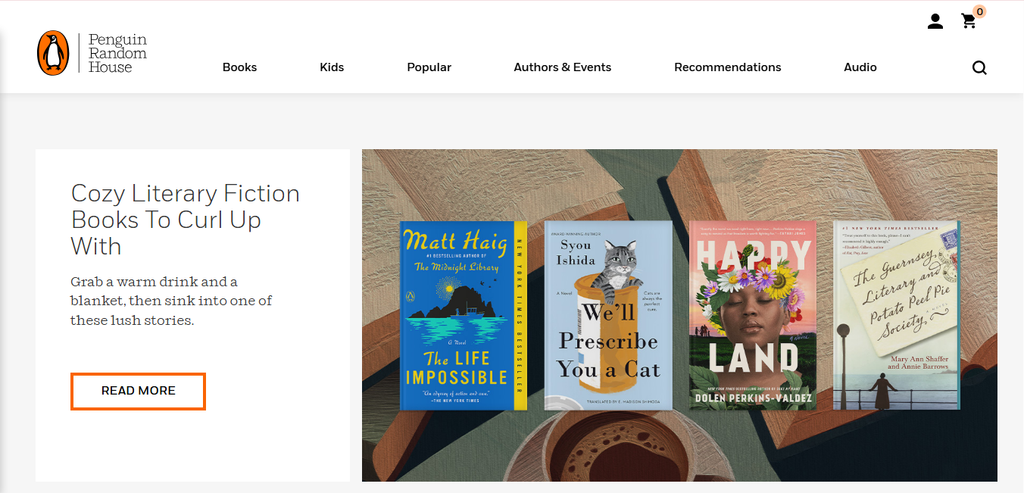
Source: Penguin Random House
Penguin Random House is the biggest name in the book business. It was formed in 2013 when Random House and Penguin joined forces, and it now runs many imprints from New York. You don’t pay it a cent. Instead, it pays you an advance, then covers editing, design, printing, sales, and marketing.
That sounds like a dream, and for some authors it is. But the door is tight. The company’s US arm doesn’t read unsolicited manuscripts, so you need a literary agent first.
Timelines run long too, since many books reach shelves a year or more after the deal. In return, you get bookstore muscle that no self publisher can buy.
Think of it as a trade. You give up control and most rights, and you gain reach.
| Detail | Info |
| Founded | 2013, when Random House and Penguin merged |
| Headquarters | New York, New York |
| Publishing Services | Editing, design, printing, sales, marketing, publicity, audio |
| Genres Supported | Fiction, nonfiction, memoir, children’s, young adult, cookbooks, and more |
| Average Publishing Cost | $0 to you. The publisher pays an advance. Typical royalties run 10% to 15% of list price on hardcovers and about 25% of net on ebooks |
| Distribution Options | Bookstores, libraries, schools, and online retailers worldwide |
| Notable Authors or Titles | Michelle Obama’s Becoming (Crown), John Grisham (Doubleday) |
| Pros | Advance, full editorial team, unmatched bookstore reach |
| Cons | Agent required, slow timeline, little control over cover, price, and rights |
| Best For | Authors with an agent, a platform, and patience |
Key Takeaway. Don’t query Penguin Random House directly. Land an agent first, because the US house won’t read your manuscript without one.
3. Harper Collins
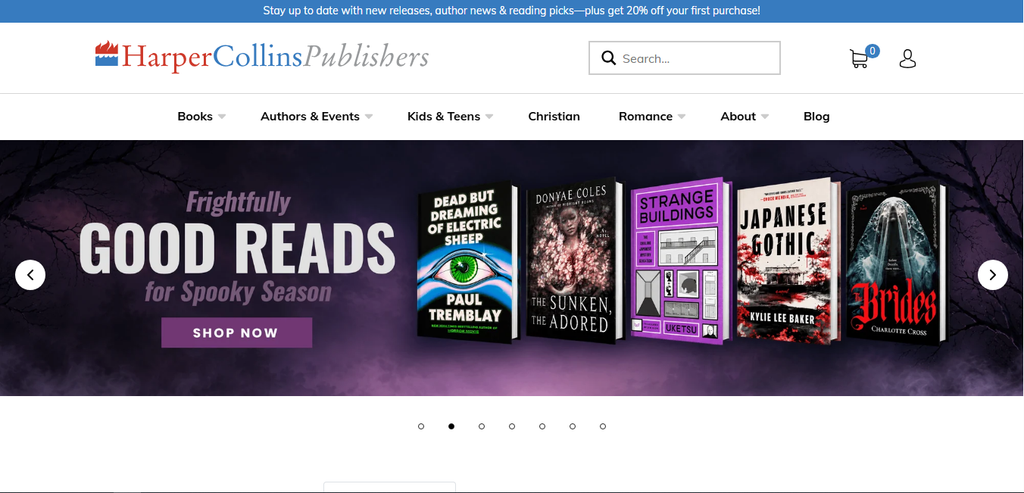
Source: Harper Collins
HarperCollins dates back to 1817, making it one of the oldest names in American publishing. Today it runs imprints in romance, faith, science fiction, cooking, and children’s books.
Like the other Big Five houses, it pays you an advance and carries the production bill. That includes editing, cover design, printing, and sales. You also get a sales team with deep bookstore and library ties.
The catch sounds familiar. Most imprints want an agent, and the publisher usually holds your rights for years. Faith authors should look at HarperCollins Christian Publishing, which includes Thomas Nelson and Zondervan.
Romance and fantasy writers should study imprints like Avon and Harper Voyager before they query. A tight match between your book and an imprint’s list matters more than the big name on the spine.
| Detail | Info |
| Founded | 1817, as J. and J. Harper |
| Headquarters | New York, New York |
| Publishing Services | Editing, design, printing, sales, marketing, audio |
| Genres Supported | Romance, science fiction, fantasy, faith, cooking, children’s, general fiction and nonfiction |
| Average Publishing Cost | $0 to you. The publisher pays an advance and royalties |
| Distribution Options | Bookstores, libraries, schools, and online retailers worldwide |
| Notable Authors or Titles | Harper Lee’s To Kill a Mockingbird, Agatha Christie’s mysteries |
| Pros | Strong faith, romance, and sci fi imprints, plus a full team |
| Cons | Agent needed, long timeline, publisher holds rights for years |
| Best For | Faith and genre authors with an agent |
Key Takeaway. Study the imprint list before you query. A faith book sent to a sci fi editor goes nowhere, and agents notice sloppy targeting.
4. Simon & Schuster
Source: Simon & Schuster
Simon & Schuster launched in 1924 and still carries weight in nonfiction, memoir, and commercial fiction. Imprints such as Scribner and Atria shape its list. The deal looks like the other Big Five deals.
You get an advance, a full editorial team, and national sales. You hand over most rights and some control. Here’s a detail new authors miss.
Simon & Schuster also distributes books for other presses, and She Writes Press uses it for exactly that. So a hybrid route can put your book in front of the same sales force.
It isn’t the same as a traditional deal, though. You still pay the bill, and the hybrid press, not Simon & Schuster, holds your contract. Always ask who signs the paper.
| Detail | Info |
| Founded | 1924 |
| Headquarters | New York, New York |
| Publishing Services | Editing, design, printing, sales, marketing, audio, distribution for other presses |
| Genres Supported | Commercial and literary fiction, nonfiction, memoir, children’s |
| Average Publishing Cost | $0 to you. The publisher pays an advance and royalties |
| Distribution Options | Bookstores, libraries, schools, and online retailers worldwide |
| Notable Authors or Titles | Stephen King (Scribner), Colleen Hoover (Atria) |
| Pros | Strong nonfiction list, full team, national sales |
| Cons | Agent needed, slow timeline, publisher holds rights |
| Best For | Memoir and commercial authors with an agent |
Key Takeaway. A hybrid press that distributes through Simon & Schuster gets you shelf access, not a Simon & Schuster deal. Read the contract to see who holds what.
5. Hachette Book Group
Source: Hachette Book Group
Hachette Book Group is the US arm of the French publisher Hachette Livre. It took its current form in 2006 and works from New York. Imprints like Little, Brown and Grand Central cover thrillers, big nonfiction, and young adult hits.
Hachette pays an advance and funds the whole book. Its US team also doesn’t take unsolicited manuscripts, so an agent stands between you and a deal.
That’s fine if your book fits a clear commercial lane, such as a thriller, a business title, or a celebrity memoir. The sales team knows how to push those. A quiet literary experiment may land better with a smaller press.
Don’t chase a big logo if the imprint’s list doesn’t match your book. A mismatch gets a polite no, then a long silence.
| Detail | Information |
| Founded | 2006, in its current US form |
| Headquarters | New York, New York |
| Publishing Services | Editing, design, printing, sales, marketing, audio |
| Genres Supported | Thrillers, nonfiction, business, young adult, and general fiction |
| Average Publishing Cost | $0 to you. The publisher pays an advance and royalties |
| Distribution Options | Bookstores, libraries, schools, and online retailers worldwide |
| Notable Authors or Titles | James Patterson, Stephenie Meyer’s Twilight (Little, Brown) |
| Pros | Strong commercial list, big sales force, full team |
| Cons | Agent needed, tough fit for niche or quiet books |
| Best For | Authors with commercial, high concept books and an agent |
Key Takeaway. Big commercial lanes suit Hachette. If your book sits between categories, test smaller presses before you burn your best agent pitch.
6. Macmillan
Source: Macmillan
Macmillan began in 1843 as a family firm, and its US operation now works from New York. Its strength lies in its imprints. Tor leads in science fiction and fantasy.
Minotaur covers crime. Farrar, Straus and Giroux focuses on literary work. Each imprint has its own editors, its own taste, and its own track record. So when you research Macmillan, you’re really researching one imprint.
Like its Big Five peers, Macmillan pays an advance, funds editing and design, and sells to bookstores and libraries. Most imprints want an agent. Smart authors read an imprint’s recent releases first.
If three books on the list sound like yours, you may have found a home. If none do, move on and save the postage.
| Detail | Info |
| Founded | 1843 |
| Headquarters | New York, New York (US operation) |
| Publishing Services | Editing, design, printing, sales, marketing, audio |
| Genres Supported | Science fiction, fantasy, crime, literary fiction, nonfiction, children’s |
| Average Publishing Cost | $0 to you. The publisher pays an advance and royalties |
| Distribution Options | Bookstores, libraries, schools, and online retailers worldwide |
| Notable Authors or Titles | Brandon Sanderson (Tor), Louise Penny (Minotaur) |
| Pros | Imprints with clear tastes, advance, full team |
| Cons | Agent needed, imprint fit matters, slow timeline |
| Best For | Sci fi, fantasy, crime, and literary authors with an agent |
Key Takeaway. Research the imprint, not the parent company. Editors at an imprint buy books, and they buy what matches their list.
7. Amazon KDP
Source: Amazon KDP
Amazon KDP remains the primary launchpad for self-published authors, offering free uploading for eBooks, paperbacks, and hardcovers on a print-on-demand basis. Authors retain full copyright, set list prices, and receive direct monthly royalty payouts.
Under the updated 2026 guidelines, eBooks priced between $2.99 and $12.99 qualify for a 70% royalty rate (reflecting the expanded $12.99 price ceiling). Print royalties yield 60% for paperbacks priced at $9.99 or higher—and 50% for those below, calculated before printing cost deductions. While standard print distribution focuses on Amazon marketplaces, enrolling in Expanded Distribution reduces your rate to 40% before printing fees.
KDP also requires explicit disclosure during submission whenever you use AI-generated text, images, or translations in a manuscript.
| Detail | Info |
| Founded | 2007, with the first Kindle |
| Headquarters | Seattle, Washington (Amazon) |
| Publishing Services | Self serve ebook, paperback, and hardcover publishing, Kindle store listing, Amazon Ads |
| Genres Supported | All genres within Amazon content rules |
| Average Publishing Cost | $0 to publish. On 70% ebooks, Amazon deducts $0.15 per megabyte of file size |
| Distribution Options | Amazon stores worldwide, plus Expanded Distribution for print |
| Notable Authors or Titles | Hugh Howey’s Wool, Andy Weir’s The Martian |
| Pros | Free, fast, and you keep your rights |
| Cons | Amazon centered reach, print cost cuts your royalty, AI disclosure rules |
| Best For | First time authors who sell mostly on Amazon |
Key Takeaway. KDP is the cheapest place to start. Just don’t build your whole plan on one store, because Amazon changes its rules often.
8. Lulu
Source: Lulu
Lulu stands as one of the pioneer print on demand companies in the independent publishing space, offering reliable service for decades. Based in North Carolina, they allow creators to print paperbacks, hardbacks, and calendars with zero upfront inventory costs.
You can use their free tools to format your book and distribute it directly through your own website or plug it into global retail networks. They offer competitive profit splits, giving authors a high share of revenue on direct sales through the Lulu bookstore.
Their platform is straightforward, reliable, and free to use unless you purchase optional editing or design services. While their customer support can feel slow during peak seasons, their core printing engine operates with impressive consistency.
Creators who want to sell books directly to their audience or test physical copies without risking thousands of dollars find Lulu exceptionally useful.
- Founded: 2002
- Headquarters: Morrisville, North Carolina
- Publishing Services: Print on demand, direct sales tools, global distribution
- Genres Supported: Fiction, nonfiction, poetry, photo books, workbooks
- Average Publishing Cost: Free platform use, pay per print copy
- Distribution Options: Lulu bookstore, Amazon, Ingram network
- Notable Authors or Titles: Various independent creators and educators
- Pros: Free platform, excellent direct sale profit margins, reliable print quality
- Cons: Basic features require paid upgrades, support can be slow
- Best For: Educators and creators focusing on direct sales and custom print projects
Key Takeaway: Lulu provides reliable print on demand services with strong profit margins on direct sales.
9. Atmosphere Press
Source: Atmosphere Press
Atmosphere Press is a selective hybrid publisher founded by literature scholars who champion ethical contracts and human connection. Located in Austin, Texas, they provide high quality editing, gorgeous interior design, and personalized distribution without the predatory traps common in vanity publishing.
Authors retain full copyright ownership and keep ninety percent of net royalties, which is exceptionally generous for a hybrid model. Their packages range from seven thousand to fifteen thousand dollars depending on editorial depth and marketing scope.
They reject manuscripts that do not meet their literary standards, ensuring their catalog maintains high professional integrity.
Every author works with a dedicated managing editor who provides genuine guidance from manuscript to marketplace.
If you want traditional editorial rigor combined with independent control, Atmosphere Press offers a refreshing and transparent alternative.
- Founded: 2015
- Headquarters: Austin, Texas
- Publishing Services: Hybrid publishing, professional editing, design, distribution
- Genres Supported: Literary fiction, poetry, memoirs, nonfiction
- Average Publishing Cost: Seven to fifteen thousand dollars
- Distribution Options: Global wholesale and retail channels
- Notable Authors or Titles: Various award winning literary authors
- Pros: High royalty retention, ethical contracts, rigorous literary standards
- Cons: Selective submission process, significant upfront investment
- Best For: Literary authors and poets wanting high editorial standards and fair terms
Key Takeaway: Atmosphere Press blends rigorous literary editing with author friendly hybrid contracts.
10. Greenleaf Book Group
Source: Greenleaf Book Group
Greenleaf Book Group represents an elite independent publisher and distributor known for helping business leaders and thought provoking authors reach major retail markets.
Based in Austin, Texas, they operate a hybrid model that secures traditional distribution channels usually reserved for massive publishing houses. They manage everything from developmental editing and professional design to warehousing and retail sales representation.
The company describes access to retail distribution channels, but distribution availability does not guarantee that a bookstore will stock a title physically. Before signing, ask which distributors and retailers are included, whether the service covers wholesale ordering or active sales representation, and what marketing or placement support is contractually promised.
Pricing is tailored and falls on the higher end, often requiring investments starting around twenty thousand dollars.
Authors maintain their intellectual property rights while leveraging Greenleaf’s powerful distribution muscle.
While the financial barrier is steep, business owners and corporate executives gain massive credibility and retail visibility through this powerhouse publisher.
- Founded: 1997
- Headquarters: Austin, Texas
- Publishing Services: Full service hybrid publishing, physical distribution, marketing
- Genres Supported: Business, leadership, nonfiction, memoir
- Average Publishing Cost: Twenty thousand dollars and up
- Distribution Options: Major physical bookstores, libraries, online retailers
- Notable Authors or Titles: Various corporate leaders and business experts
- Pros: Elite physical retail distribution, professional corporate branding
- Cons: Very high financial investment, selective acceptance criteria
- Best For: Corporate executives and business authors needing major retail shelf space
Key Takeaway: Greenleaf Book Group secures elite physical retail distribution for established business authors.
11. She Writes Press
Source: She Writes Press
She Writes Press is a unique independent hybrid publishing company created specifically to empower women authors in a male dominated industry. Founded by publishers who wanted an alternative to traditional gatekeeping, this press provides a collaborative community and professional production standards.
They handle editing, cover design, interior layout, and traditional distribution through Ingram. Authors pay an upfront production fee, retain their copyright ownership, and receive seventy percent net royalties, which far outpaces traditional publishing deals.
Submission requires an application and editorial review to maintain high quality across their catalog. Their community aspect provides peer support, virtual masterclasses, and promotional networking that helps women successfully launch their stories.
If you are a woman writer looking for a supportive ecosystem and professional polish, She Writes Press is a stellar choice.
- Founded: 2012
- Headquarters: Berkeley, California
- Publishing Services: Hybrid publishing, editorial services, design, distribution
- Genres Supported: Fiction, nonfiction, memoirs by women authors
- Average Publishing Cost: Five to ten thousand dollars
- Distribution Options: Ingram wholesale network, major retailers
- Notable Authors or Titles: Penny Lane, Sherry Stanfa Stanley
- Pros: Dedicated community for women writers, high royalties, professional quality
- Cons: Selective application process, upfront costs apply
- Best For: Women authors and memoirists seeking a supportive professional community
Key Takeaway: She Writes Press empowers women writers with professional hybrid publishing and strong community support.
12. Amplify Publishing Group
Source: Amplify Publishing Group
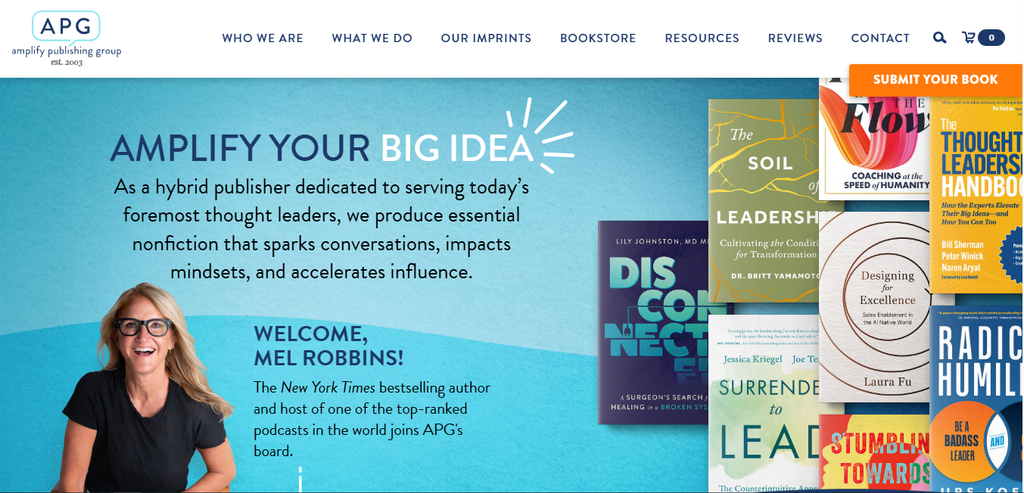
Amplify Publishing Group specializes in thought leadership, corporate memoirs, and high impact nonfiction written by experts and entrepreneurs. Based in Washington state, they focus on helping leaders turn their ideas into authoritative books that drive business growth.
They provide full service editorial, custom design, strategic marketing, and distribution through major retail channels. Their team works like a traditional publisher by curating submissions, but authors fund the production process through custom hybrid packages.
Pricing reflects a white glove experience, often falling in the mid to high five figures. Authors retain strong ownership rights and benefit from specialized marketing campaigns tailored to speaker platforms and corporate visibility.
If you are a CEO or industry speaker wanting to leverage a book for professional authority, Amplify delivers exceptional business results.
- Founded: 2003
- Headquarters: Dulles, Virginia
- Publishing Services: Hybrid publishing, thought leadership marketing, design
- Genres Supported: Business, nonfiction, leadership, entrepreneurship
- Average Publishing Cost: Ten to twenty five thousand dollars
- Distribution Options: Major retail and wholesale networks
- Notable Authors or Titles: Various prominent entrepreneurs and leaders
- Pros: Strong focus on author platform growth, professional business positioning
- Cons: Expensive packages, narrow focus on nonfiction
- Best For: Corporate leaders and keynote speakers building business authority
Key Takeaway: Amplify Publishing Group turns industry experts into authoritative authors with targeted business positioning.
13. PublishDrive
Source: PublishDrive
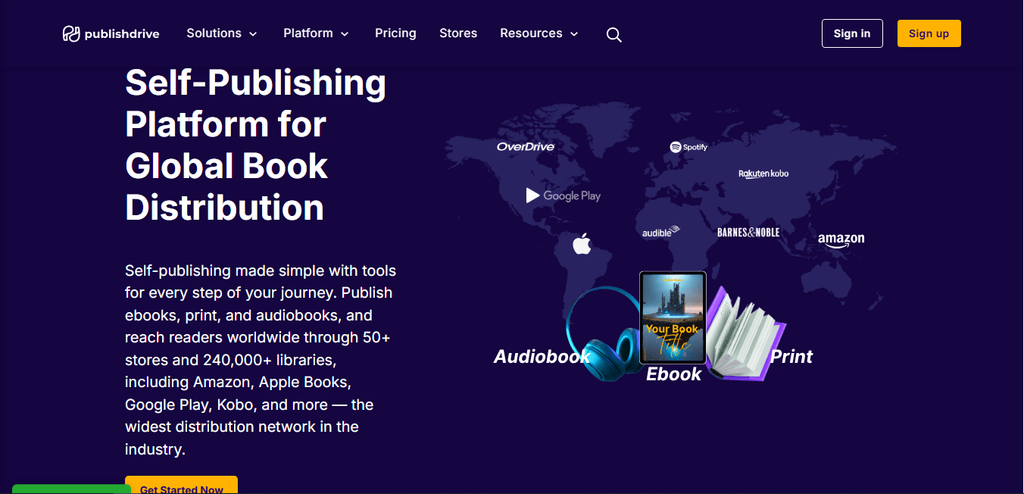
PublishDrive functions as a flat fee ebook aggregator that lets creators distribute their titles to thousands of stores and libraries worldwide without taking a commission cut on sales.
Instead of taking ten percent of your royalties like traditional aggregators, they charge a predictable monthly or annual subscription fee.
This model benefits high earning authors who keep one hundred percent of their store royalties. Their platform reaches international markets, digital subscription services, and school libraries across more than one hundred countries. They also offer print on demand capabilities and promotional tools to boost sales visibility.
While beginners with low sales volume might find subscription fees harder to justify, established indie authors with multiple titles save substantial money by avoiding commission cuts.
PublishDrive gives prolific creators complete financial control over their digital earnings.
- Founded: 2015
- Headquarters: Budapest, Hungary and New York
- Publishing Services: Ebook and print distribution aggregation, flat fee model
- Genres Supported: All ebook and print genres
- Average Publishing Cost: Monthly subscription starting around ten dollars
- Distribution Options: Four hundred plus stores and libraries worldwide
- Notable Authors or Titles: Various international independent authors
- Pros: Zero commission cut on sales, massive global library reach, flat fee structure
- Cons: Subscription fees require steady sales to remain cost effective
- Best For: Prolific indie authors with high sales volume keeping all royalties
Key Takeaway: PublishDrive charges flat subscription fees so you keep one hundred percent of your digital sales.
14. Forefront Books
Source: Forefront Books
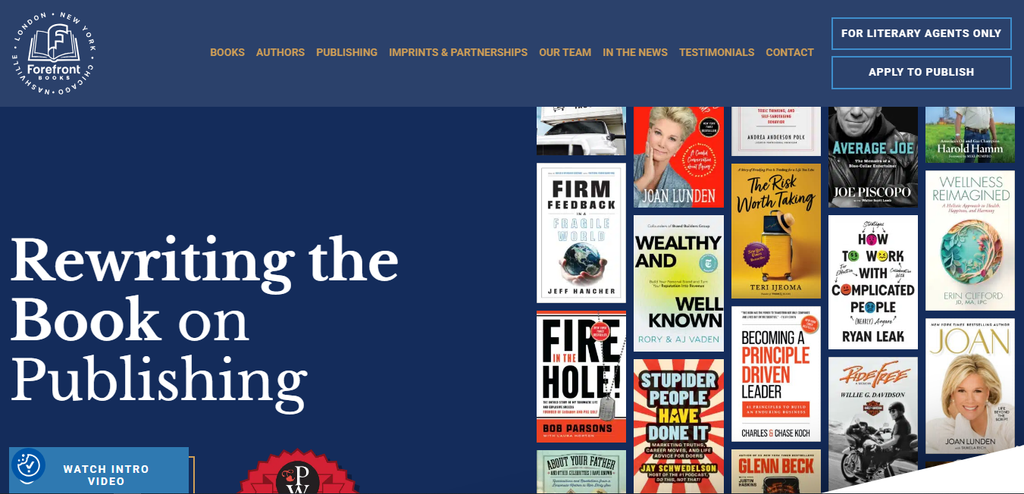
Forefront Books operates as a premier hybrid publisher focusing on high impact business, leadership, and narrative nonfiction books. Partnered with major traditional distributors, they give independent authors access to mainstream retail channels while maintaining collaborative control.
Their team includes seasoned publishing veterans who manage developmental editing, stunning cover art, and strategic publicity campaigns. Authors invest upfront capital to fund production, but they receive a much higher percentage of royalties compared to traditional book deals.
Forefront is selective, seeking out authors with established platforms, strong speaking credentials, or unique stories that resonate with broad audiences.
Their partnership model bridges the gap between self publishing freedom and traditional retail prestige, making them a top tier destination for serious nonfiction writers and industry leaders.
- Founded: 2018
- Headquarters: Charleston, South Carolina
- Publishing Services: Hybrid publishing, editorial development, distribution, publicity
- Genres Supported: Nonfiction, business, leadership, memoir
- Average Publishing Cost: Fifteen to thirty thousand dollars
- Distribution Options: Major bookstore chains and online wholesalers
- Notable Authors or Titles: Victoria Song, JT Jester
- Pros: Mainstream distribution partnerships, seasoned publishing team, high quality
- Cons: High financial investment, strict curation criteria
- Best For: Established experts and speakers seeking mainstream retail placement
Key Takeaway: Forefront Books offers mainstream distribution and veteran guidance for established nonfiction authors.
15. StreetLib
Source: StreetLib
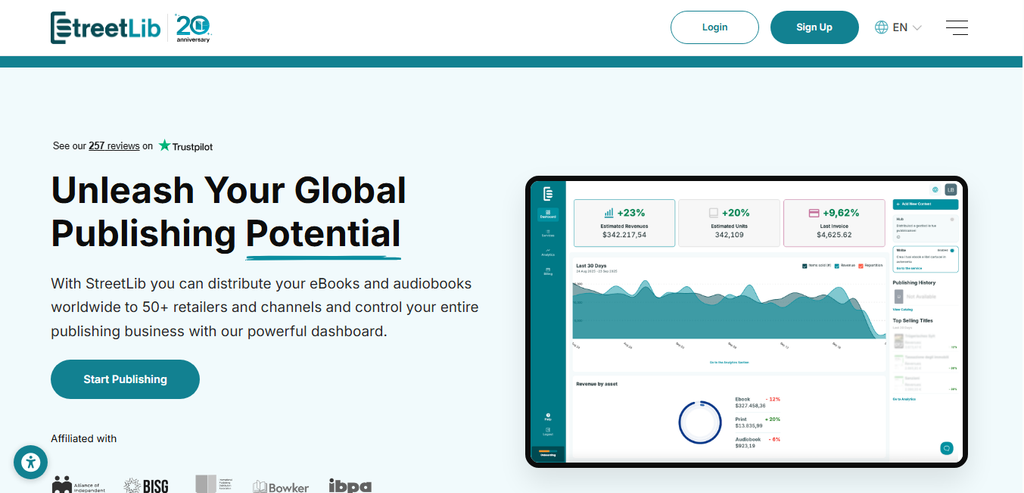
StreetLib is an international publishing aggregator that provides wide digital distribution with a heavy emphasis on European and emerging global markets. Based in Italy, they help independent authors push their ebooks, audiobooks, and paperbacks to stores across Europe, Latin America, and beyond.
They offer a flexible commission model or annual fee structure depending on the services you need. Their platform is especially valuable for creators wanting to translate and distribute their work outside English speaking territories.
They also provide free ISBN allocation for ebooks and simple dashboard management tools. While their interface has a slight learning curve for North American users, their international reach is unmatched by domestic competitors.
If you want to tap into foreign markets and sell your books across European digital stores, StreetLib is an incredible asset.
- Founded: 2006
- Headquarters: Milan, Italy
- Publishing Services: Global digital aggregation, international distribution, translation support
- Genres Supported: All genres
- Average Publishing Cost: Free setup with commission or annual fee plans
- Distribution Options: Hundreds of international bookstores and digital platforms
- Notable Authors or Titles: Various European and international indie authors
- Pros: Unmatched European market reach, multi format distribution, flexible pricing
- Cons: Interface can be confusing for beginners, localized support varies
- Best For: Authors targeting international and European reading markets
Key Takeaway: StreetLib connects your titles to European and international digital stores with ease.
Best Book Publishing Companies by Service Type
Choosing the right company depends entirely on what kind of help you need. Some authors want to handle everything themselves while others want professionals to manage the entire workflow from scratch.
If you are seeking a comprehensive partner to guide your project from initial draft to global storefronts, Liberty Book Writers offers a customised, end-to-end full-service solution.
They manage ghostwriting, developmental editing, professional formatting, bespoke cover design, and worldwide distribution, enabling you to launch a polished, market-ready title without the hassle of coordinating multiple freelancers or managing technical software.
Bad Formatting Kills Good Books. We Fix That.
Don’t let clunky layouts, weak covers, or hidden publishing traps sink your hard work. Our end-to-end publishing team handles every detail—editing, design, and multi-channel launch—so your book looks and sells like a New York Times favorite.
Get Your Custom QuoteBest Full-Service Self-Publishing Companies
Full service companies take your raw manuscript and turn it into a finished book while you sit back and watch. Brands like MindStir Media and BookBaby handle editing, design, formatting, and distribution for a set fee.
This path suits busy professionals who lack technical skills or time to manage freelancers. You pay upfront, but you save countless hours of headache.
Best Ebook Publishing Platforms
Digital reading platforms let you publish ebooks instantly for zero dollars. Amazon KDP dominates this category, but Apple Books, Kobo Writing Life, and Google Play Books offer fantastic alternative storefronts.
Publishing directly to these platforms gives you maximum royalty percentages and direct control over your digital pricing strategies.
Best Ebook Aggregators
Aggregators save you from juggling a dozen separate publisher accounts. Platforms like Draft2Digital and PublishDrive take your single EPUB file and push it to hundreds of digital stores and libraries worldwide.
They make going wide effortless, letting you reach international readers without losing your mind.
Best Print-on-Demand Services
Print on demand technology lets physical books get printed only when a customer buys them, eliminating expensive bulk inventory costs.
IngramSpark and Lulu lead this category by connecting indie authors to global printing networks. Your books get manufactured and shipped on demand with zero garage space required.
Best Audiobook Publishing and Distribution Services
Audiobooks represent the fastest growing segment in the publishing industry. Platforms like Findaway Voices and Amazon ACX let you produce and distribute audio versions of your book.
You can hire narrators on a royalty share basis or pay upfront for professional voice talent to bring your story to life.
Best Book Marketing Services
Marketing makes or breaks your book sales. Even the best manuscript will sit gathering dust without promotional muscle. Specialized book marketing firms help run targeted Amazon ads, secure editorial reviews, and build author websites.
Mentioning Best Ghostwriting Services right here reminds you that your content quality must match your marketing hype for long term success.
Book Retailers vs Aggregators vs Full-Service Publishers
Understanding business models prevents costly mistakes. Retailers sell books directly to consumers.
Aggregators distribute your files to multiple retailers. Full service book publishers in USA manage the entire production process for a fee. Know the difference before you spend your hard earned money.
What Is a Book Retailer?
A book retailer is a storefront where readers buy books. Amazon, Apple Books, and Barnes and Noble are prime examples. Publishing directly on these platforms costs nothing, and you deal with the retailer on your own terms.
What Is a Book Aggregator and How Does It Work?
An aggregator is a middleman that pushes your book to multiple retailers at once. Instead of uploading your file to ten different websites, you upload it once to an aggregator, and they send it everywhere for a small fee or percentage cut.
What Is a Full-Service Self-Publishing Company?
A full service company acts as your creative agency. They provide editing, cover design, layout formatting, and distribution under one roof. You pay them upfront for their labor, and you retain your publishing rights and royalties.
Which Publishing Option Is Right for You?
Your choice depends on your budget, technical skills, and career goals. If you have zero budget and love learning technical steps, free platforms are your best bet.
If you have spare cash and want professional hand holding, a hybrid or full service publisher is the right path.
Ebook Publishing Costs
Publishing an ebook can cost literally zero dollars if you format your own file and design a simple cover using free tools.
Hiring a professional formatter and cover designer usually costs between two hundred and six hundred dollars.
Print Book Publishing Costs
Printing physical books requires interior formatting, cover wrapping, and ISBN acquisition.
Buying your own ISBN from Bowker costs about one hundred twenty five dollars, while print setup fees range from zero to fifty dollars depending on the platform you choose.
Professional Editing Cover Design and Formatting Costs
Skimping on editing and cover design is the fastest way to kill your book sales. Developmental editing costs between one thousand and three thousand dollars. Copyediting and proofreading run several hundred dollars.
Professional cover design ranges from three hundred to fifteen hundred dollars. Quality work requires real investment.
Audiobook Production Costs
Audiobook production is billed per finished hour of audio. Hiring a professional narrator typically costs between two hundred and four hundred dollars per finished hour.
A standard eight hour book can easily cost two to three thousand dollars to produce professionally.
Book Marketing and Promotion Costs
Marketing budgets depend on your goals. Running targeted Amazon ads or hiring a public relations firm can cost anywhere from five hundred to five thousand dollars. Never skip marketing unless you enjoy selling zero copies.
What Is an ISBN and What Do You Need to Know About It?
An International Standard Book Number (ISBN) identifies a specific edition and format of a book in many book-trade systems. Requirements vary by format, retailer, and distribution channel, so authors should check the rules that apply to their planned publication.
- Free versus purchased ISBNs: Some self-publishing platforms offer free ISBNs for eligible print books. These may identify the platform or its designated imprint as the publisher and may have restrictions on use outside that platform. Buying your own ISBN can give you greater control over your publisher identity, subject to the rules of your national ISBN agency.
- ISBNs versus copyright: An ISBN identifies a publication; it does not establish copyright ownership. Copyright and any licenses granted to publishers or service providers should be addressed separately in the relevant contract.
- Production files and accounts: Confirm in writing who owns or may use the cover artwork, interior layout, and other commissioned assets. Check whether you can receive your final files and transfer distribution accounts when a service agreement ends.
Hidden Fees and Royalty Considerations
Read your contracts closely. Some companies charge hidden storage fees, annual maintenance fees, or take a massive slice of your royalties.
Make sure you understand the difference between net revenue and list price royalties before signing on the dotted line.
2026 Publishing Policy Changes First-Time Authors Should Know About
The publishing industry shifts rapidly with new artificial intelligence disclosure rules, stricter file review guidelines, and changing distributor algorithms.
Platforms now require explicit disclosure if you use generative artificial intelligence tools in your writing or cover creation. Staying updated on these policies prevents sudden account bans or distribution freezes.
How to Evaluate a Book Publishing Company Before Signing
Never sign a contract without vetting the company thoroughly. Look for transparent pricing, clear royalty terms, and real author testimonials.
Avoid vanity presses that make grand promises while demanding massive upfront checks with little return.
Check Publishing Fees and Royalty Rates
Know exactly what you are paying for and what percentage of sales you keep. Legitimate companies are transparent about their fees and do not hide predatory clauses in fine print.
Review Distribution Rights and ISBN Ownership
Always check who owns your ISBN and distribution rights. You should always own your ISBN and retain full copyright ownership of your intellectual property. (For further insight, please read the description above regarding ISBN, which will elucidate the trade-offs and distinguish between ISBN, copyright, and licensed rights.)
Avoid contracts that lock you into exclusive distribution without fair compensation.
Understand Copyright and Contract Terms
Never surrender your copyright to a self publishing company. You created the work, so you must own the rights.
Check termination clauses so you can pull your book out if the company underperforms.
Verify Marketing Promises and Author Testimonials
Be skeptical of companies promising guaranteed bestseller status or millions of readers.
Check independent review sites and talk to real authors who worked with them before handing over your money.
Check Withdrawal Refund and Termination Policies
Life happens and business relationships sour. Make sure your contract includes a clear exit clause allowing you to terminate the agreement and retrieve your files without paying exorbitant penalty fees.
What Most Book Publishing Guides Miss
Most guides ignore the brutal reality of post publication maintenance. Publishing the book is only the starting line.
You must continuously update metadata, run promotional campaigns, and engage with your readership to maintain momentum. Success takes persistent effort long after the launch party ends.
Closing Thoughts
Choosing the right path to bring your manuscript to life defines your journey as an author. Whether you decide to manage every technical detail yourself on direct platforms or partner with structured full-service platforms, focusing on professional production quality remains non-negotiable.
Always protect your intellectual property rights, review contract terms carefully, and invest in top-tier editing and cover design to give your book the competitive edge it deserves in today’s crowded market.
Your story deserves an expert team that understands your vision and turns your draft into a stunning retail reality. We handle everything from manuscript development and custom layout to global retail distribution, ensuring your book stands out on every shelf.
Take the next confident step toward becoming a successfully published author today by choosing professional book publishing services from Liberty Book Writers.
Confused by Publishing Options? Let’s Map Your Path.
Self-publishing, hybrid, or print-on-demand? Navigating the modern book market can feel like a minefield. Skip the guesswork and partner with experienced publishing strategists who will map out a clear, step-by-step launch plan tailored to your budget.
Book a Free Strategy CallFrequently Asked Questions
The best choice depends on your budget and creative goals. Direct self-publishing platforms like Amazon KDP and IngramSpark offer maximum control, while full-service hybrid providers handle design, editing, and distribution.
Also Working with established publishing companies like Liberty Book Writers ensures professional quality, clear royalties, and wide global reach across top retail markets.
First-time writers thrive on user-friendly self-publishing platforms like Amazon KDP, Draft2Digital, or BookBaby. These popular publishing companies provide easy setup tools, clear guidance, and low entry costs.
For hands-on help, reputable hybrid companies offer tailored publishing services that simplify editing, cover design, and retail distribution for beginners.
Costs range from zero dollars on free self-publishing platforms to between $1,000 and $5,000 for professional self-publishing services. High-end hybrid packages can cost upwards of $10,000.
Your total budget covers essential services like professional developmental editing, custom cover art, interior formatting, and targeted launch marketing campaigns.
Traditional publishing companies never charge authors upfront fees; they pay you an advance and royalties. However, paying legitimate hybrid or self-publishing companies for professional editing, design, and distribution services is standard practice.
Avoid predatory vanity presses that make false claims or demand exorbitant fees without delivering real value.
Most self-publishing platforms and hybrid self-publishing companies welcome new creators instantly without traditional agent representation. Independent presses like Atmosphere Press and She Writes Press regularly review unsolicited manuscripts.
If pursuing traditional paths, target literary agents who represent debut authors to secure deals with major traditional publishing services.
Self-publishing platforms generally allow authors to submit eligible books without securing a traditional publishing deal, subject to platform rules and review.
Short non-fiction guides, specialized niche memoirs, and digital novellas are the easiest to produce and release. These genres require less complex layout work and target clear, specific audiences.
Utilizing self-publishing platforms lets you upload your manuscript quickly and start selling to global readers within just a few days.
Releasing your book today is simpler than ever thanks to accessible self-publishing services. While traditional gatekeepers maintain strict entry barriers, modern platforms let any writer publish globally.
The real challenge lies in investing in quality editing, professional cover design, and persistent marketing to stand out among top self-publishing companies.