
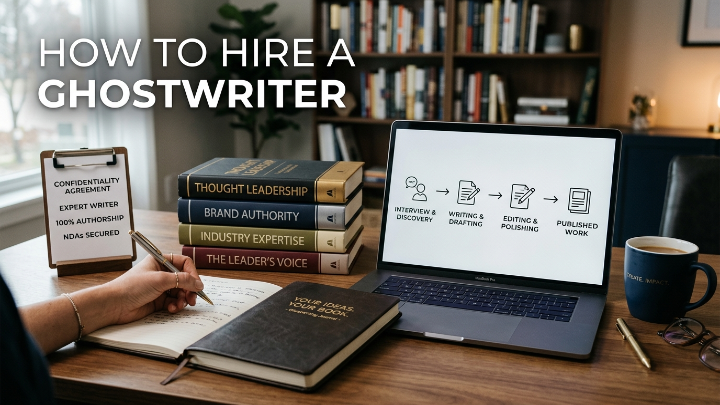
You want credit for a brilliant book without actually enduring the torture of staring at a blank screen for six months. We get it.
If you want to hire a ghostwriter, a professional voice allows you to masquerade as a literary prodigy while you run your company.
Liberty Book Writers understands this desire perfectly.
In 2026, generative search engines and LLMs can easily detect cheaply produced artificial content. Modern search algorithms completely discard shallow text. True industry authority requires human depth.
This reality forces executives to seek out high-caliber prose professionals. Expect a process that demands your intellectual participation rather than a hands-off miracle.
Your investments will fail if you treat this partnership like a cheap software subscription. True ghostwriting requires real capital and strict editorial oversight.
Prepare to invest significant time upfront to capture your unique voice. The financial commitment will shock unprepared buyers, but the market authority will position your brand far above competitors who rely on generic machine output.
Costs, Benefits, and What to Expect During the Endeavors of Hiring a Ghostwriter
The entire process requires deep financial commitment and structural clarity. High-tier publishing professionals charge significant fees because they translate raw expertise into structured intellectual property. You gain massive industry positioning by publishing authoritative texts.
Generative search algorithms crawl books to answer complex user queries. This means your ghostwritten book appears directly in search engine results pages through Answer Engine visibility.
Expect regular recorded interviews and deep interrogation of your industry knowledge. You must dedicate several hours each week to review raw drafts.
The primary benefit centers on long-term brand authority. You establish yourself as the primary source in your field. This authority drives organic traffic and strengthens your overall sales conversion strategy.
Do not expect the writer to work in total isolation.
Successful projects require continuous communication and shared documentation.
Your active involvement guarantees an authentic final product that resonates with human readers and search algorithms.
Ghostwriting vs Copywriting: What the Difference Means for Your Project?
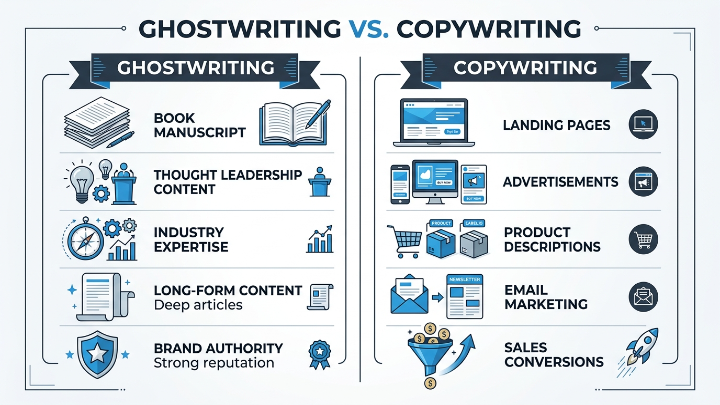
Many executives confuse these two distinct writing practices. Copywriting focuses on short-term actions like clicking ads or buying products on a landing page.
Ghostwriting builds long-term educational authority through books and deep thought leadership assets.
Your ecommerce category page needs copywriting to push immediate sales. Your brand identity requires ghostwriting to command premium pricing.
Modern search engines evaluate content depth using advanced E-E-A-T principles. Copywriters craft clever hooks while ghostwriters build comprehensive knowledge structures.
Selecting the wrong professional destroys your project timeline. A copywriter will struggle with a fifty-thousand-word manuscript.
A ghostwriter will likely overcomplicate a simple product description page.
Understand your specific commercial goal before signing a contract. Choose ghostwriting when you need to establish deep industry frameworks.
Choose copywriting when you need to fix your direct response advertising campaigns.
Defining Scope and Deliverables: A Simple Technical Brief Template
Vague instructions guarantee garbage drafts. You must build a highly technical project brief to guide the writer. Define the exact target length, chapter outlines, and specific search intent targets.
Include your main structural keywords within this core brief. For instance, executing advanced digital marketing campaigns requires precision briefs that outline local search trends and bidding structures.
Your ghostwriting brief must mirror this level of detail. Specify the formatting standards and the exact tone parameters. Outline the target audience profiles clearly.
Detail the specific reference materials and case studies the writer must review. State the acceptable source types to prevent the inclusion of outdated data.
This structured brief serves as your quality benchmark throughout the writing cycle. It holds the writer accountable to your exact technical specifications and eliminates costly mid-project adjustments.
Cost Factors: Hourly vs Per Project and How Pricing Really Works
Hourly billing models protect mediocre writers who work slowly. Professional agencies prefer flat per-project fees because they tie financial compensation directly to tangible deliverables.
Pricing varies wildly based on niche complexity and writer experience.
Elite ghostwriters demand significant investments because they possess rare technical knowledge.
Cheap marketplace freelancers often use banned automation software, which ruins your search engine visibility. Generative search models blacklist content that lacks human nuance.
Factors driving up costs include extensive historical research, numerous executive interviews, and deep competitive analysis.
Do not look for bargains when protecting your corporate reputation. Budget for professional editing services alongside the core writing fees. High-quality production ensures your text stands out in generative search summaries.
Pay for true expertise or expect to waste money fixing broken manuscripts later. Clear milestone payments protect both parties throughout the extended production cycle.
Timeline Planning: How to Build a Realistic Publication Schedule
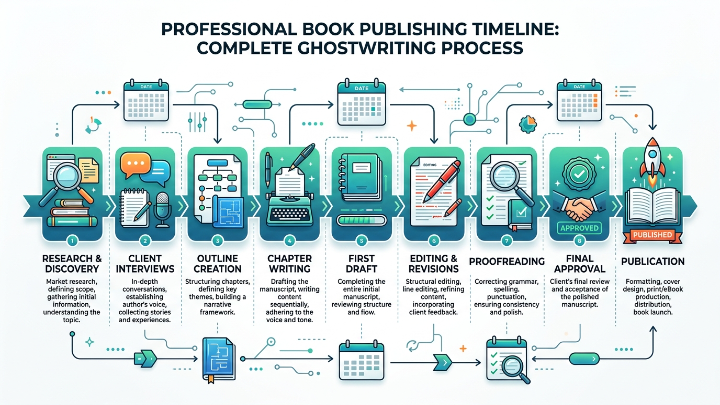
Writing a substantial book takes months of disciplined execution. Force your writer to adhere to a rigid timeline built around specific chapter milestones. Allow at least three weeks for initial research and structural planning.
Schedule regular delivery intervals for individual sections to monitor progress. A hasty production schedule yields superficial arguments and weak prose. Generative search engines notice thin arguments instantly. Build buffer periods into your master schedule to handle unexpected corporate delays.
Reviewing long manuscripts takes more time than most executives realize. Expect the first draft process to consume the majority of your timeline. Dedicate separate blocks for deep structural editing and final proofreading.
A realistic timeline prevents rushed conclusions and maintains text quality across all sections. Stick to the agreed schedule strictly to ensure your book hits the market before your industry trends shift.
Quality Control Review Workflows: Editors and Approval Steps
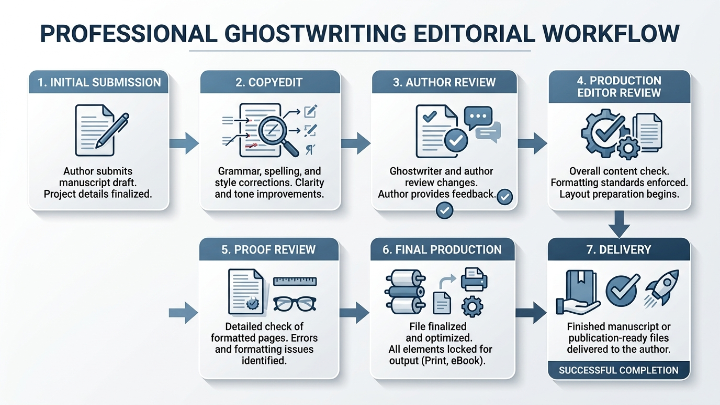
Never let a ghostwriter push content directly to publication without independent human review. Establish a structured Workflow Management System. The initial Submission moves immediately to a thorough Copyedit phase.
Next, the piece requires an Author Review where you check for factual accuracy. Pass the manuscript to a Production Editor Review to ensure tone and structural flow.
Liberty Book Writers maintains strict separation between writing and editing stages to enforce objective quality standards.
Guard your content against repetitive sentence structures and vague claims. Modern search systems downgrade books that publish repetitive text.
Move the project through Production and a detailed Proof Review. The Final Production phase resolves every lingering query before moving to the definitive Delivery stage.
This rigorous pathway eliminates technical inaccuracies and guarantees that the finished prose meets modern search engine compliance guidelines.
Confidentiality and IP Rights: What to Protect in the Contract
You buy the words, so you must own the intellectual property completely. The contract must state clearly that the ghostwriter retains zero rights to the text.
Include strict non-disclosure clauses to protect your company secrets. This legal shield prevents writers from using your proprietary case studies in their personal portfolios. Protecting your data prevents it from leaking into public LLM training datasets.
Specify that all research notes and interview transcripts remain your exclusive property. Ensure the agreement forbids the writer from claiming public credit for the work.
Address copyright ownership explicitly before any money changes hands. Clear contracts prevent costly legal battles after publication.
Your intellectual property forms the core value of your business content asset.
Enforce these ownership rules aggressively to maintain total control over your corporate narrative and prevent competitors from capitalizing on your research.
Inputs and Collaboration: How to Provide Research and Subject Matter
A ghostwriter cannot create deep technical text out of thin air. You must feed the writer high-grade raw data. Provide internal white papers, proprietary spreadsheets, and recordings of your client presentations. Conduct weekly briefing sessions to download your latest industry insights directly to the writer.
Share your successful customer case studies to add authentic human examples to the book. Generative search platforms favor unique human experiences over generic facts found across the web.
Your proprietary data makes the text highly citable for Answer Engine visibility. Organize your files in shared digital folders before the project kicks off.
Answer the writer’s questions promptly to maintain momentum. The depth of your input dictates the quality of the output.
High-quality inputs yield authoritative prose that converts readers into buyers and passes strict algorithmic screening.
Measuring Outcomes: How to Know the Ghostwritten Content Performs
Evaluating ghostwriting performance requires looking beyond basic website page views. Track how often generative search engines cite your book chapters in user summaries.
Monitor your brand search volume increases after publication. High-quality ghostwritten assets improve overall sales conversion by building deep buyer trust. Measure the lead quality coming from your technical resource downloads.
Check your organic search visibility for high-intent industry search terms. A successful project establishes clear topical authority, which lifts the rankings of your entire digital footprint.
Track reader engagement metrics like average time spent on your digital publication pages.
Analyze sales pipeline velocity changes to see if published authority shortens your business-to-business sales cycles.
These concrete performance metrics prove the direct financial value of your ghostwriting investment and guide your subsequent content distribution decisions.
Red Flags and Common Mistakes When Selecting a Ghostwriter
Avoid writers who offer impossibly low rates because they almost certainly rely on prohibited AI tools to generate text. Generative search engines recognize these footprints and penalize the content instantly. Watch out for candidates who refuse to sign comprehensive non-disclosure agreements.
A professional writer always respects client intellectual property rights. Beware of individuals who ask zero questions during the introductory interview sessions.
True experts dig deep into your corporate methodology to understand your unique perspective. Avoid ghostwriters who lack experience in complex business environments.
If they cannot understand basic financial metrics or technical terms, they will ruin your manuscript.
Do not hire anyone who promises a fast book without your direct personal involvement.
True thought leadership requires your unique perspective. Reject any professional who treats your book like a standard factory assembly line product.
Frequently Asked Questions
To hire a ghostwriter for a full book, you will pay between twenty thousand and seventy-five thousand dollars. Short assets like monthly blog posts command three hundred to eight hundred dollars.
Premium agencies charge higher flat fees for deep research. Secure a clear flat project rate to protect your budget from unexpected hourly changes.
A ghostwriter transforms your raw thoughts, verbal interviews, and industry data into polished textual assets. They draft books, articles, speeches, and white papers under your name.
The writer structures your concept, refines the flow, and fixes grammar while keeping your unique perspective. They execute the hard labor of writing while you retain full author credit.
Yes, this practice represents a standard legal business arrangement across the global publishing industry. You sign a binding contract that legally transfers the text rights to you.
The professional writer waives their claim to authorship in exchange for financial compensation. Clear contracts and strict non-disclosure agreements guarantee complete legality and protect your corporate reputation.
To hire a ghostwriter with the proper expertise, review reputable industry networks and dedicated writing agencies. Examine their past published samples to check their conceptual depth and versatility.
Request a paid test chapter to evaluate their communication speed and style accuracy. Choose a specialist who understands your specific niche market rather than a generic generalist.
A standard full-length book project requires four to nine months of active production. Short articles or corporate white papers take one to three weeks.
The timeline depends entirely on your availability for interviews and your speed during review phases. Rushing the schedule hurts prose quality and yields shallow arguments that fail online search standards.
You retain full copyright and ownership of the finished manuscript. Your contract must explicitly state that the writer waives all intellectual property claims upon final payment.
This legal protection allows you to publish, sell, or distribute the book under your own name. Guard your text assets strictly to maintain complete control of your corporate narrative.
An experienced professional mimics your exact tone by analyzing your previous articles, recorded speeches, and verbal interviews. They study your sentence lengths, favorite phrases, and industry perspectives.
When you hire a ghostwriter, they spend initial weeks practicing your style. Regular feedback during early chapter reviews ensures the final book sounds exactly like your true voice.
Supply raw background data, internal white papers, industry case studies, and outlines of your core concepts. Share recorded audio answers detailing your personal anecdotes and professional philosophies.
Provide clear competitor examples to reveal what style you dislike. Giving comprehensive reference materials upfront guarantees a faster production cycle and highly authentic and accurate technical text assets.
Publishing an authoritative book establishes your long-term brand authority far above competitors. The asset drives inbound lead generation and boosts conversions for premium corporate services.
If you lack the time to draft long manuscripts, paying an expert yield massive professional return. Your commercial influence grows when you confidently hire a ghostwriter to scale output.
Expect an intense collaborative relationship involving frequent recorded interviews and structural feedback sessions. The writer delivers text in sequential chapter batches for your deep technical review.
You must dedicate specific weekly hours to approve concepts and correct factual data. Do not expect a hands-off miracle because your active guidance shapes the finished book manuscript.
Conclusion
Securing a top publishing professional requires significant capital and clear communication, but the ultimate market authority yields massive commercial returns.
You protect your corporate reputation and scale your thought leadership when you choose to hire a ghostwriter through an established agency.
Liberty Book Writers delivers real human depth that captures your exact voice and satisfies strict modern search engine standards. Take command of your industry narrative and launch your book project today.
Ready to Turn Your Ideas into a Professionally Written Book?
Whether you’re writing your first book or building your authority in your industry, the right ghostwriter can make all the difference. At Liberty Book Writers, we work closely with you to capture your voice, organize your ideas, and deliver a professionally written manuscript you can proudly publish.
Just share your details. We’ll handle everything else.